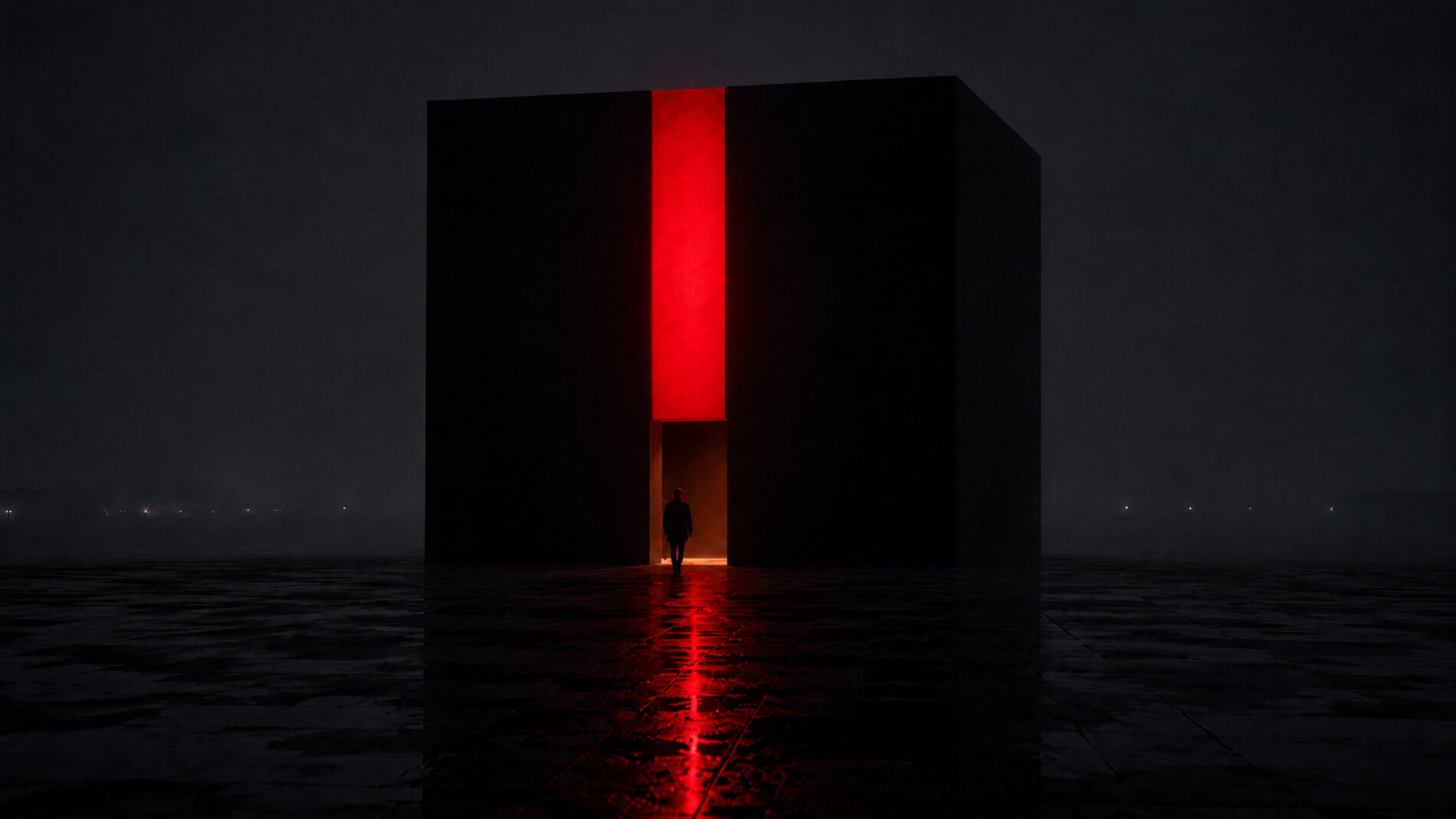
Flagship · The Cube
ACD 4
A four-metre reaction. One activation.
4 × 4 × 4 m·aluminium + LED
Terreiro do Paço · Lisboa·2027
Black outside · red within
Terreiro do Paço · Lisboa·2027
Black outside · red within
Scroll ↓
A four-metre reaction. One activation.
A four-metre cube of absolute black with one red interior — the 4 is its dimension in metres; future editions will take other numbers. Designed for a single ephemeral activation at Terreiro do Paço, Lisboa. Today it stands as a fully engineered project — drawings, gates, journey; next, it looks for the partners who will make the night happen.
A four-metre cube of absolute black. From the outside it withholds — no entrance announced, no image offered. Inside, a single red interior: the reaction the exterior refuses to show.
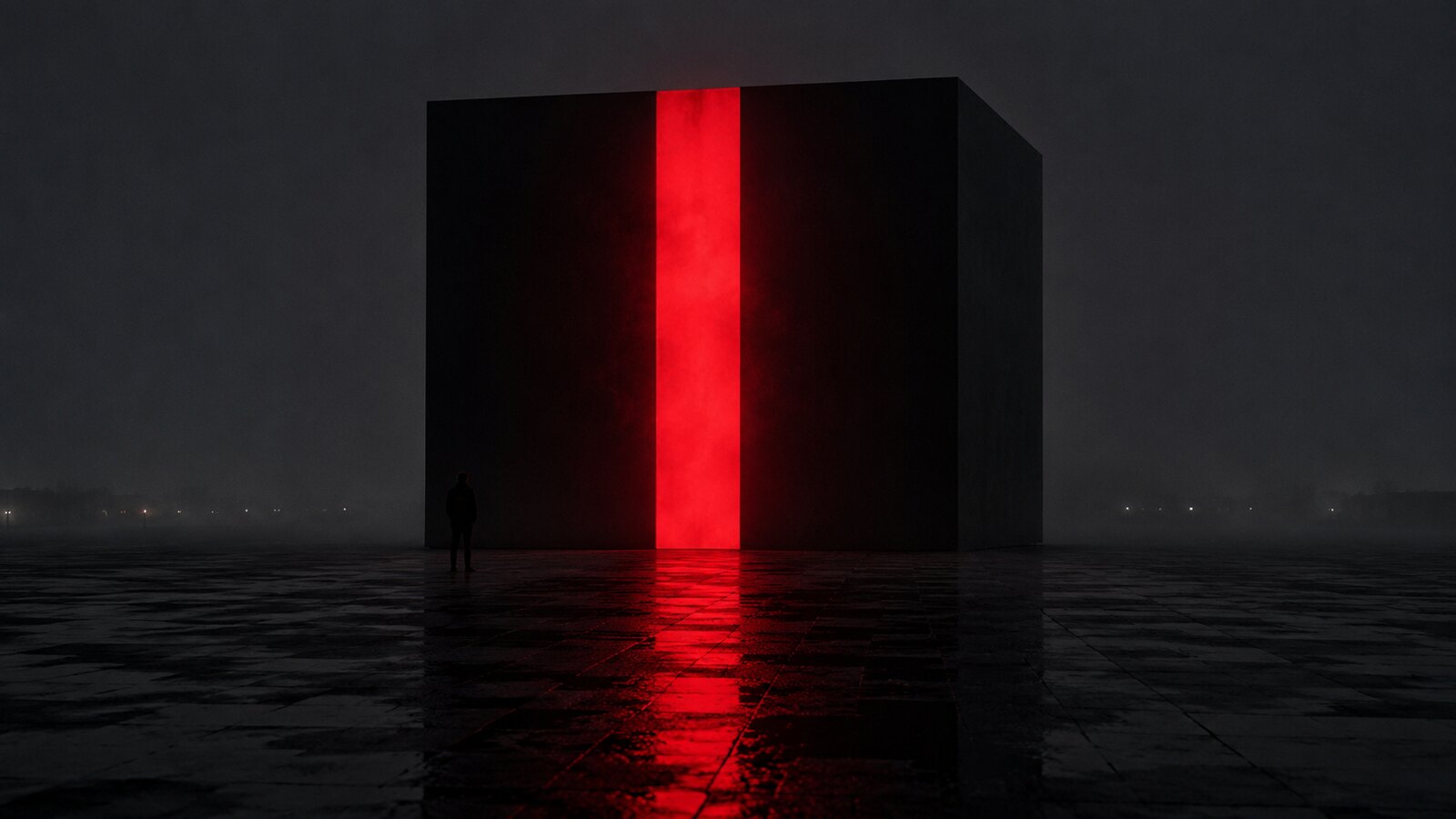
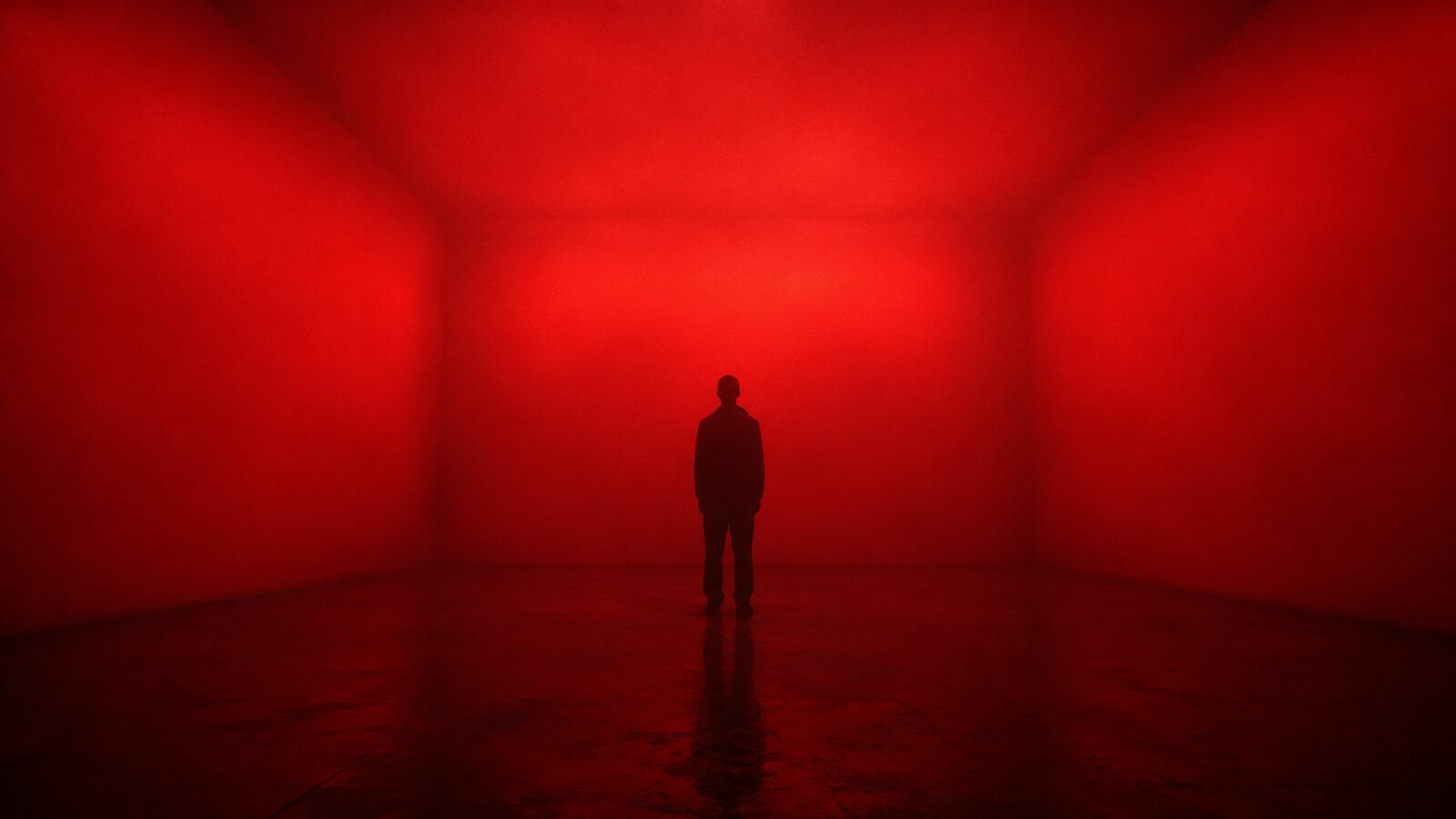
Everything originates in charcoal black. Red is what the black does to you — the acid and the threshold at once: urgency and intimacy in the same breath. The cube is not a room. It is a controlled chemical event you walk into.
Every surface today is a screen, every screen an offer — a culture that competes by accumulation: more light, more sound, more. It buys a glance and leaves short memory and long waste. AC|D 4 argues the opposite: subtraction is more disruptive than excess. It withholds, it goes dark, it gives you less — and is remembered more.
This isn't a hunch — it's engineered on how memory actually works: the mind keeps the peak and the end, not the duration (Kahneman's peak–end & duration neglect); awe appears reliably under vastness and the need to reframe (Keltner & Haidt); an atmosphere reaches the body before the mind can judge it (Böhme, Zumthor). A counter-monument that fixes itself in memory, not in the ground.
Experienced two at a time. The cube engineers one peak and a deliberate end — duration is not the unit. What you keep is the ignition and the cut, not the clock.
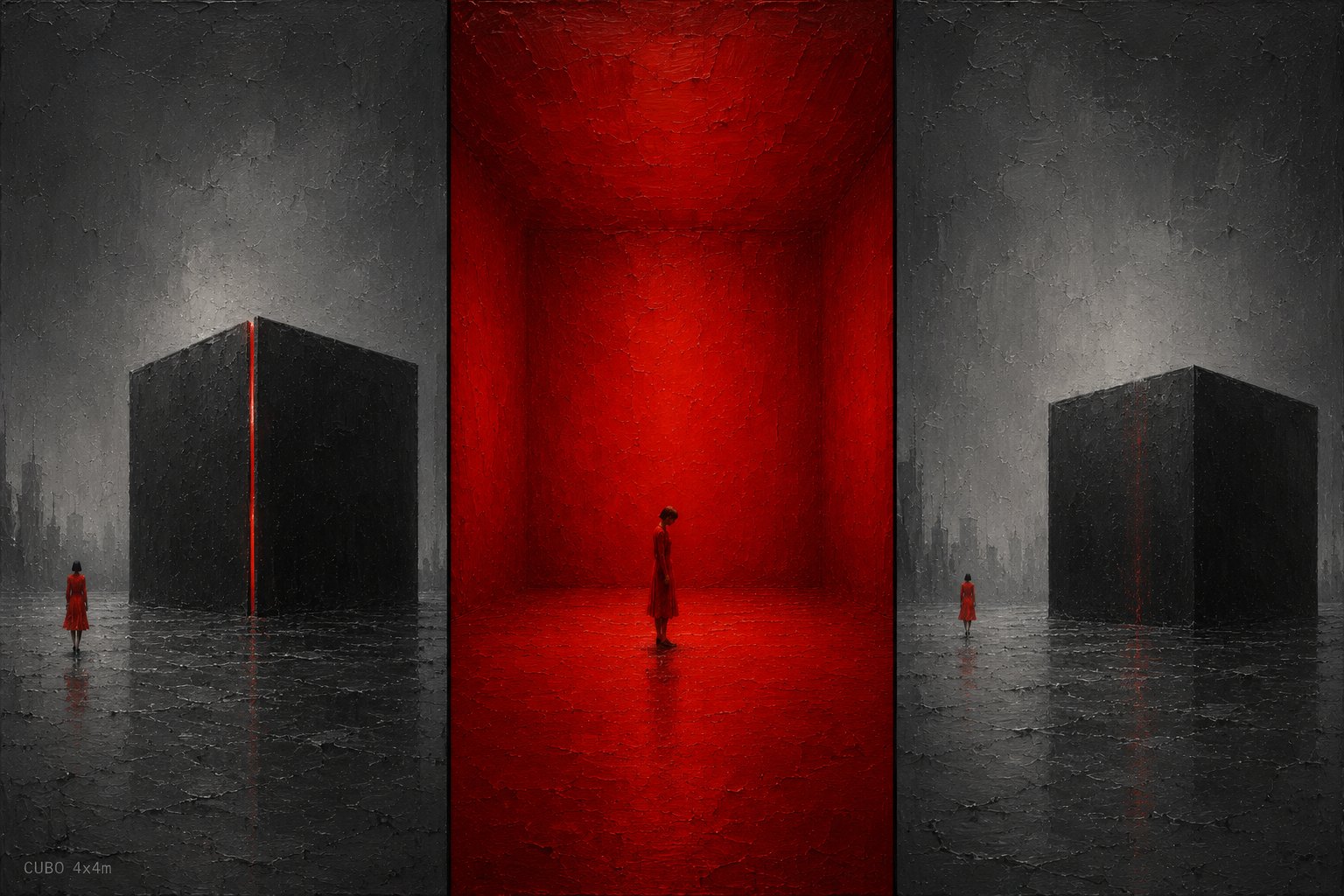
Days of a sealed black monolith that does nothing. Then, one night, the slit — a single cut of light. Nothing hinges, nothing slides: the way in is light, not a door.
At the threshold, a host presents a tray: two recast mini-cubes, one red, one dark. The host never hands them over — lifting the red cube yourself is the only yes the night asks.
Two low, lit treads rise the ~350 mm and carry you in at the base, beneath the line of light. A demountable ramp is laid over them only when a wheelchair needs it.
At your back, the dark recess closes — the single break in the wrap of light. Sight withdraws; everything else sharpens.
The red field ignites — four walls and the ceiling, one image, no edge. The field breathes on a slow tide; a 57 Hz pulse you feel rather than hear; fog rises from the floor. The peak. Time changes.
The whole field draws inward to the fenda — the slit, in Portuguese — one thin red line standing in the black — then a hard, clean cut to absolute black. No fade, no ember. A beat of total silence.
In the black the line returns for a breath as AC|D — the «|» become the slit of its own name — then gone, burning on the retina. You leave by the mirror threshold; later, one 24-hour view-once film.
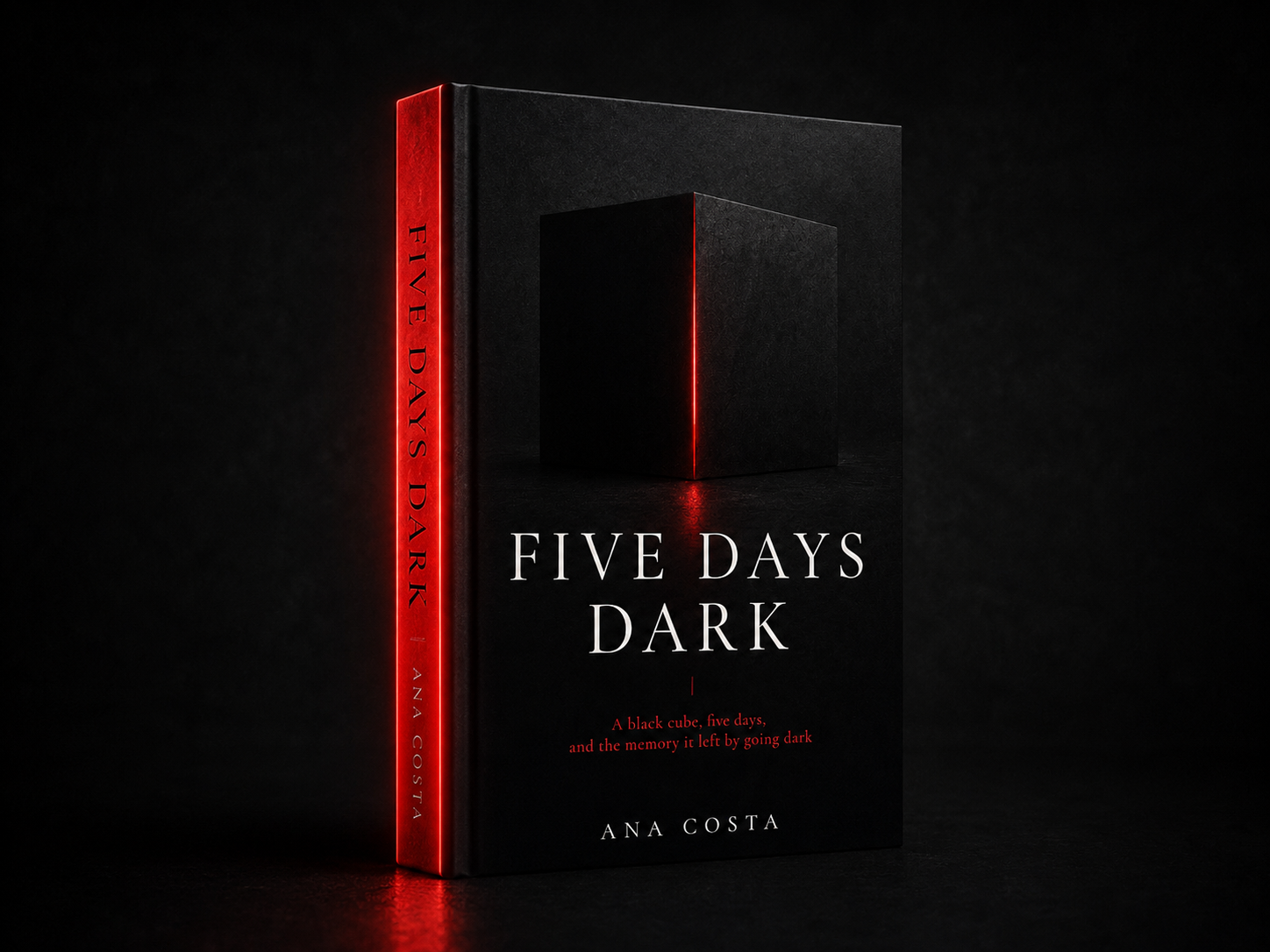
The narrative beneath the object — told as a novel in movements. Memory through reaction, not permanence. Five Days Dark is the account of one visitor who walked past a black cube that did nothing — until the fifth day.
Read an excerpt ▸A single ephemeral activation — Terreiro do Paço, Lisbon, 2027. The object disappears; what it does to you does not.
No photographs inside. At the threshold, a host presents two small recast mini-cubes on a tray — one marked red (record), one dark (skip). The host never hands them over: lifting the red cube yourself is your consent, the only yes the night asks. Hidden corner cameras film only those who lifted red; staff never touch the data. Later, the cube unlocks a single 24-hour view-once film of your passage — seen once, then gone. Privacy is built into the architecture, not bolted on. The memory is yours to keep, not to scroll.
AC|D 4 is a completed design: object, journey, structure, climate, egress and strike — engineered, drawn and costed to the gate system (G1–G5). What it does not yet have is the night itself. That is the next phase: partners.
One activation, one square, one partner set. Sponsorship carries the build — structure, LED field, climate — and in return owns a share of the only night the object will ever have: naming in the credits, the film, the edition, the RELIC recast. Subtraction is rare; that is the value.
Start the conversation ▸The cube is experienced two at a time — two who came together, never strangers grouped. When the night is confirmed, the first pairs will come from this line. One email, two names: AC|D + you.
Join the line ▸Engineered as a temporary structure — fast to raise, faster to return. Certified, rented, reusable. The numbers below are communicable design intent; the stamped figures belong to the engineers (gates G1–G5).
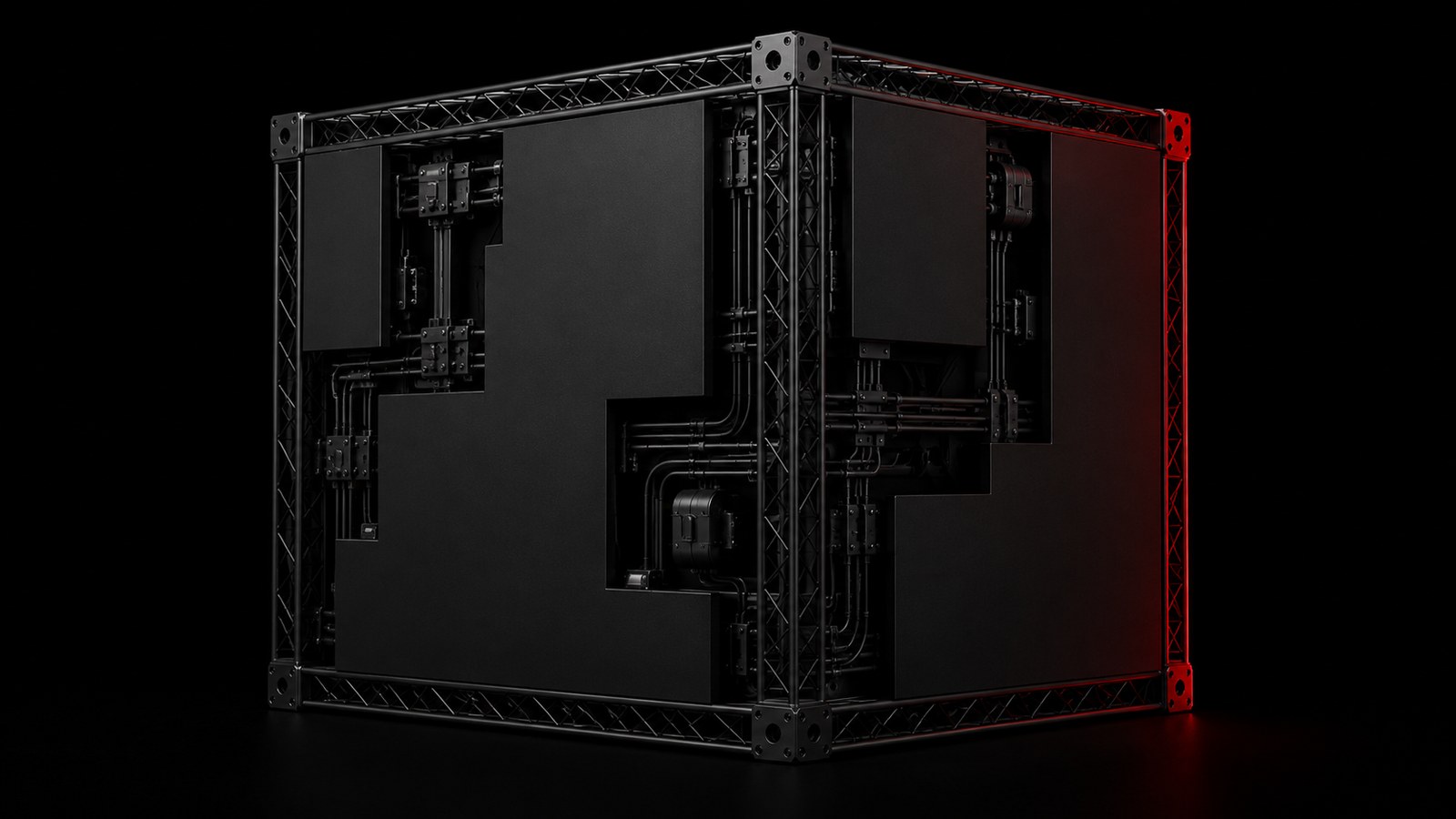
A single clear-span aluminium frame — no internal columns, because the pure void is the condition of the continuous wall of light. It sits on the ground and pierces nothing: stability lives in an integrated base inside the footprint, never exposed ballast. Wind is the governing load (EN 1991-1-4, Lisbon) — above an operational limit the slit closes and the cube reverts to a sealed monolith.
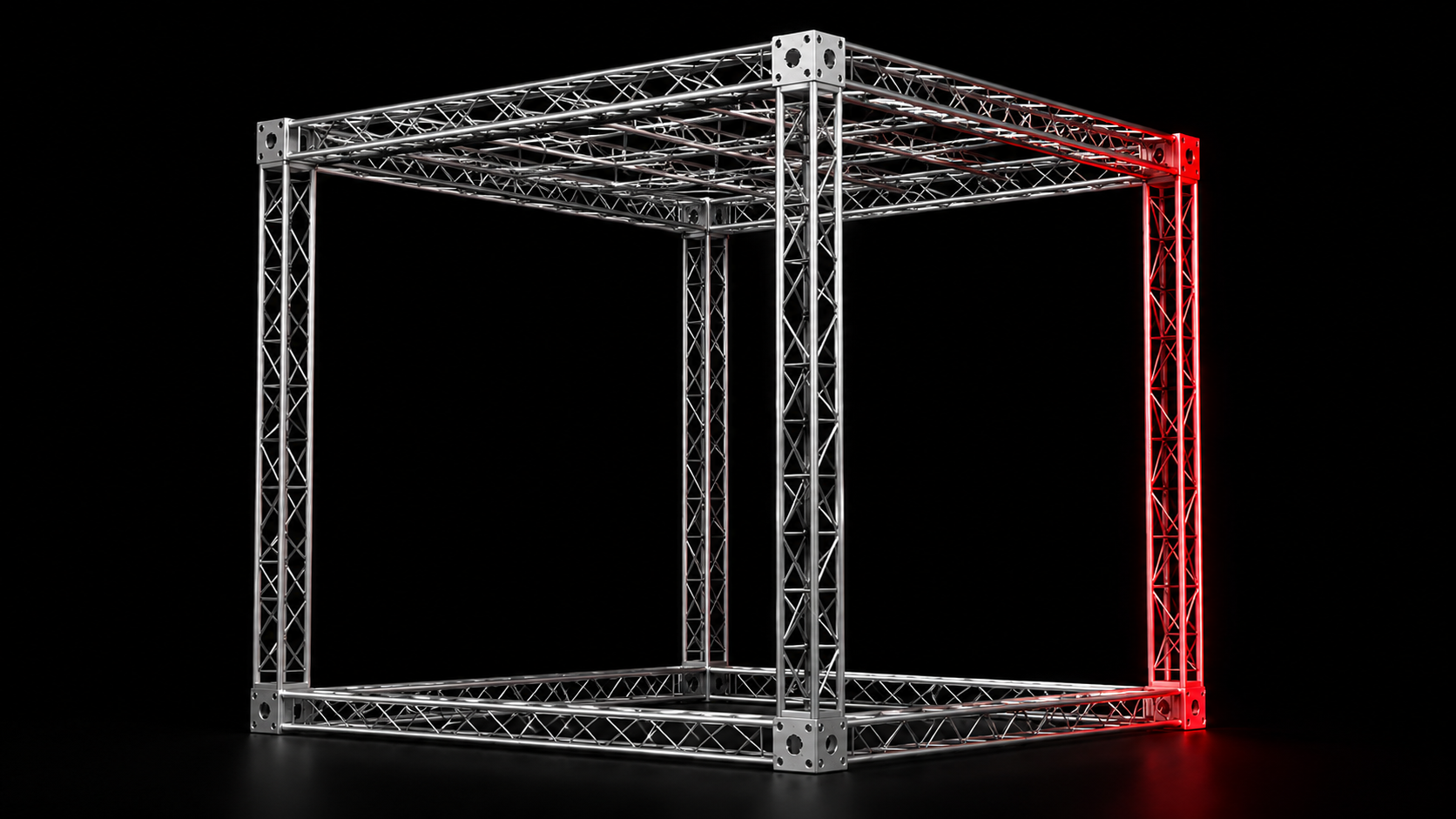
“We are not pretending the cube has no structure. We are deciding that the structure cannot become the image.”
One coordinated build-up, every layer independent and demountable — each returning to its own cycle. Six modules of 500 give the 3.0 m interior with no off-cuts.
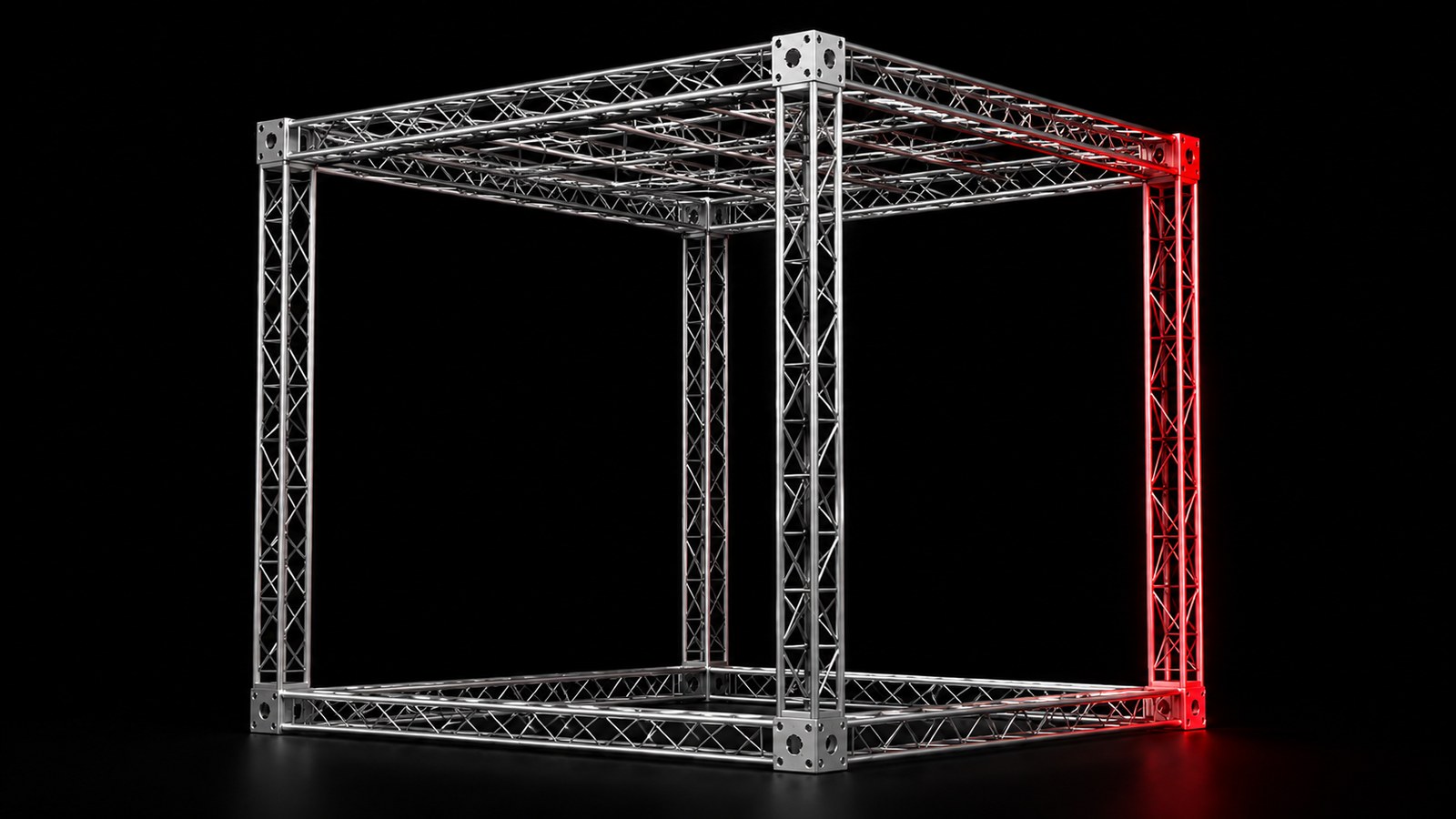
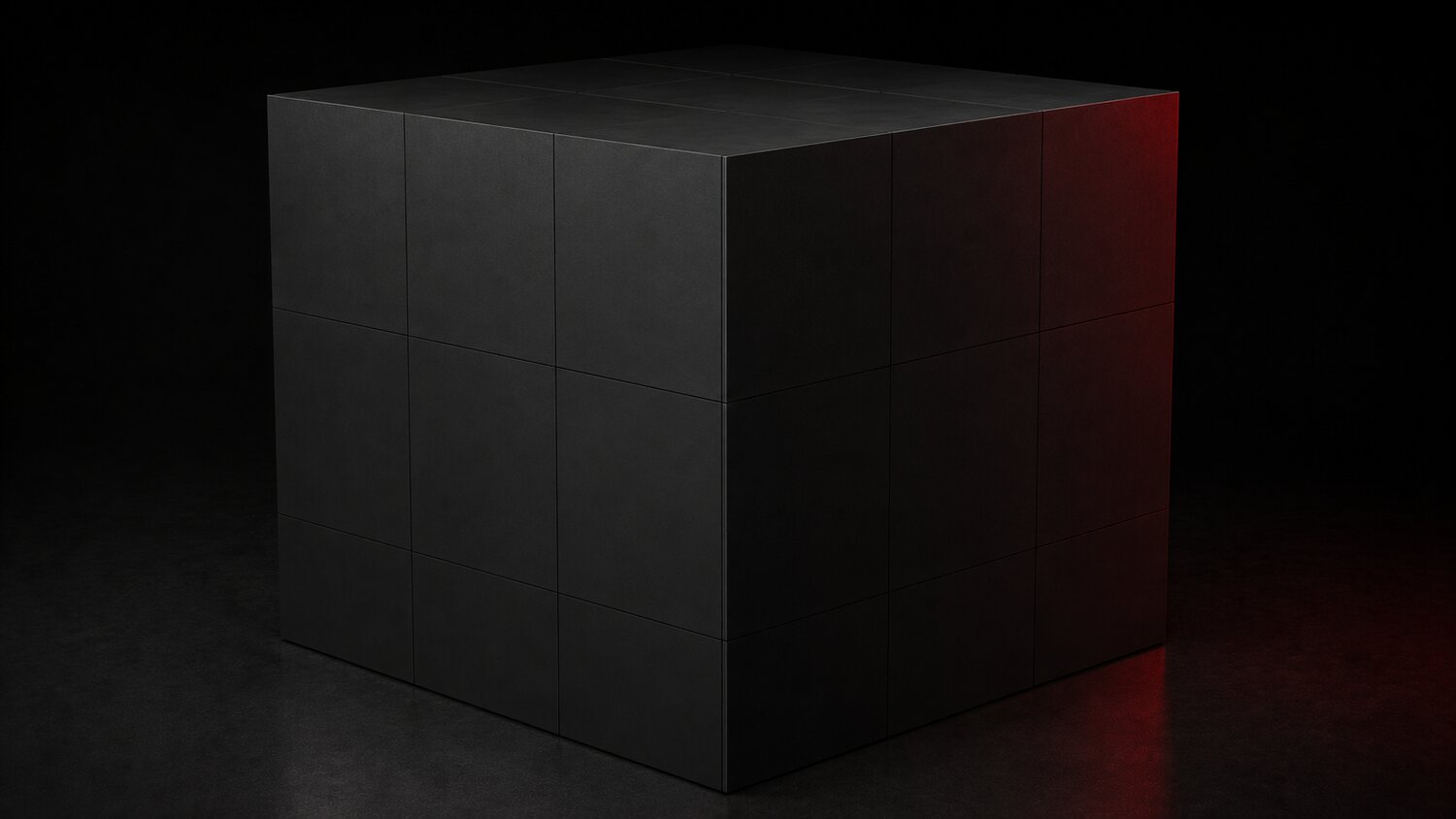
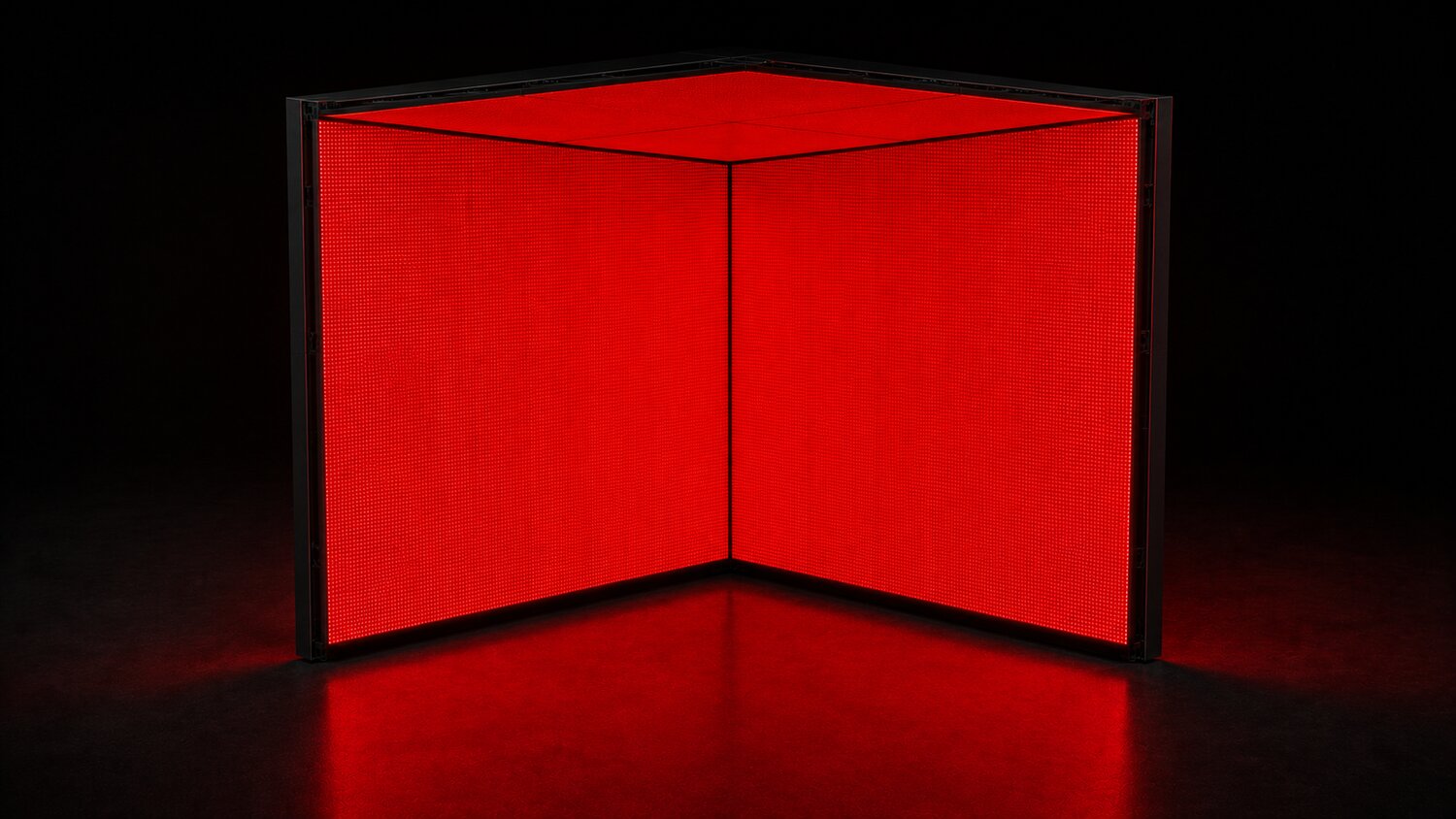
Four walls and the ceiling — one continuous image, no edge. Fine-pitch 500×500 tiles, front-serviceable, humidity-protected, pointing inward (no façade brightness needed). ~45 m², ~180 tiles, ~17 kW. The field stops ~150 mm above the floor: it hovers, and you enter beneath it.
A heel-safe micro-perforated aluminium deck (≤6 mm — passes stiletto, wheelchair, cane) over a low technical base of ~350 mm. The base holds the plant, fog, intake, the stowed ramp and — only if the wind case demands it — internal stabilising mass. Fog enters from the perimeter, at the floor.
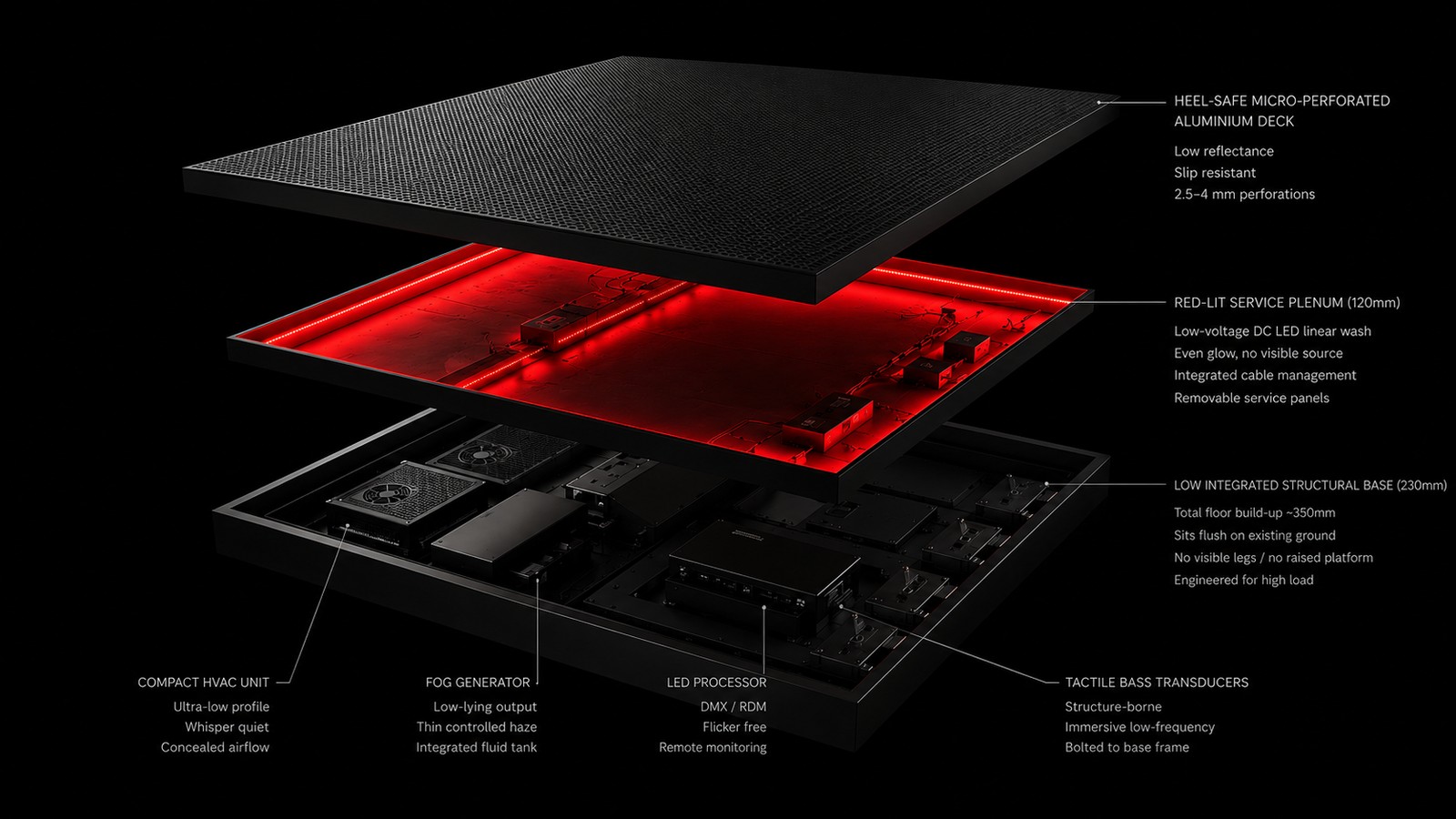
The hardest problem the cube sets itself: a sealed black box full of LED makes heat it must shed without breaking the seal. The answer is a fully conditioned envelope with two air circuits that never share a duct — dry, clean air for LED cooling; a sealed line for fog. Condenser heat is rejected downward through the technical base to the ground — the four faces stay sealed and unbroken, with no louvres or vents in the skin. No water anywhere; the only umbilical is power. (Gate G2 — HVAC engineer.)
The 360° field is driven as a single seamless image — media server + pixel-mapping, light, sound and air calibrated as one. Sound is tactile, not surround: a low ~57 Hz pulse through the floor deck, felt in the body rather than heard, with only a few hidden sources. Energy is the object's only umbilical: a discreet power cable at the base.
Enter at the front base light-trap, up two low steps; through the red field; out at the rear. Two slits on axis — the rear is also the emergency egress.
You enter at one base light-trap and leave at the other — the rear is the emergency egress, a 100% redundancy. On any alarm, Emergency Mode snaps the LED to flat white, stops fog and sound, purges the haze and holds both traps open; the steps are fixed and always passable, nothing powered to fail. (RSET ≈ 15–25 s — fire engineer, G4/G5.)
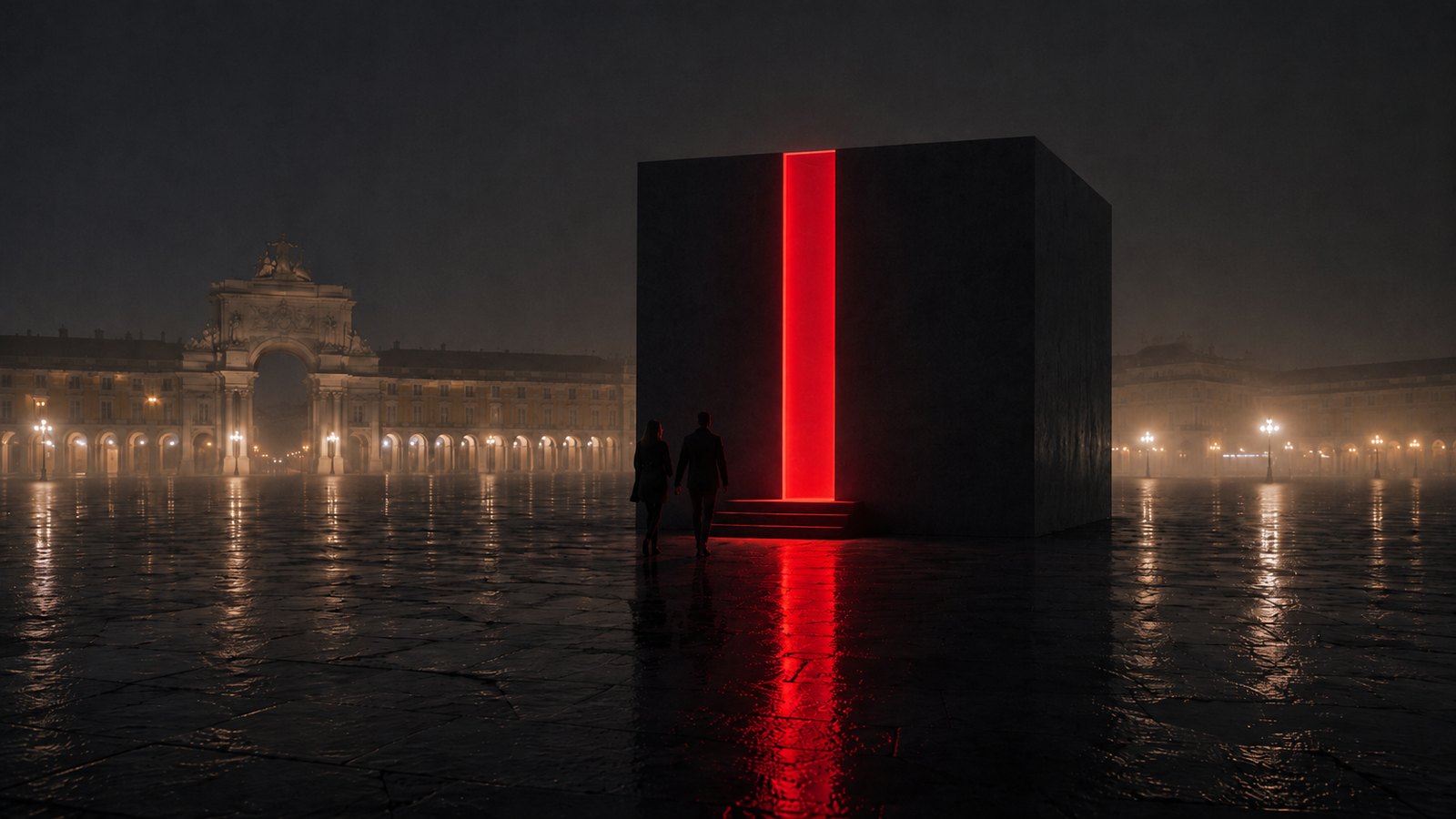
Flat-pack in, tool-less conical couplers, an access platform only for the ceiling LED — no heavy crane. Every step reversible: the strike is the build run backwards, the parts returned to rental or stock. A small load in, a small load out, and nothing to bury.
Material honesty over finish — a mono-material aluminium skin, an LED interior, no decorative cladding. Almost everything is rented and certified, struck and returned. The keepsake shares the cube's own matter (recycled-content aluminium), and a retired cube is recast into a numbered RELIC. The legacy is memory, not landfill.
The brand film that lives on the LED field — four minutes of black, red and breath, written for the inside. Sound on: the voice carries it.
Plans, sections, elevations, details and service circuits — the cube as a buildable, dimensioned system (21 sheets). Tap any sheet to enlarge.
The project stands in two documents — the Case File, the complete editorial argument from concept to return, and the Technical Dossier, the buildable companion from geometry to gates.
For five days I walked past a black cube that did nothing.
It stood in the square the way a sentence stops mid-word. Four metres of nothing, sealed on every side, no door I could find, no light, no sound, no sign telling me what it was for. People moved around it the way water moves around a stone. And every evening, crossing the same square, I caught myself looking for the change that never came.
This is a book about that cube. But it is really about a question I did not have words for until the fifth day, when the cube finally opened — and the question is this:
In a culture that has decided more is the only direction, can an object install a lasting memory by giving you less — by withholding, by refusing, by going dark — instead of by overwhelming you?
I did not arrive at that question as a theory. I arrived at it as a feeling, standing in a square, slightly anxious, faintly insulted by a black box that would not perform for me. What follows is the five days, the opening, and what I understood once I was inside.
The first time, I almost missed it.
That is the strange part, and I want to be exact about it, because everything else follows from it. A four-metre black monolith in a public square should be the loudest thing for a hundred metres. It was the quietest. The city around it was doing what cities do now — every surface had been turned into a screen, every screen into an offer. A façade pulsed a soft-drink logo across the street. A pop-up two doors down breathed fog and coloured light onto the pavement and handed out something to hold. The square was an economy of attention, and attention was being mined from me at every step.
And in the middle of all that selling, the cube sold nothing. It just absorbed. Matte black, no seam I could read, no name. Against the bright traffic of images around it, its silence was almost rude. I remember thinking: what is wrong with it? — which is, I realise now, exactly the wrong question, and exactly the one the object wanted from me.
Everything else in that square was an image of itself. The cube did not offer an image. It offered an absence where an image should be. And an absence, in a saturated field, does something stranger than any image: it makes you lean in.
I went back. I told myself it was on the way. It wasn't.
Nothing had changed, which is to say the cube was now doing its work, and its work was making me wait. I stood closer this time. Up close the black was not one black but many — a depth to it, the surface swallowing the square's reflected light instead of returning it. I put my hand near it and didn't touch. There was no information anywhere on it. No QR code, no plinth text, no opening hours. In a world that explains everything to you pre-emptively, an object that explains nothing is not neutral. It is a provocation.
This is the thing I keep coming back to: the cube refused to be assimilated. I could not file it under anything I already knew — installation, kiosk, sculpture, ad. I did not feel awe yet. I felt its cheaper cousin — irritation, curiosity, a small itch of not-knowing. But the itch was the beginning of the thing. The object had found the gap in my certainty and sat down in it.
By the third day the waiting had changed temperature.
It is worth being honest about what waiting does, because the cube was building it on purpose and I was the material. The days of sealed, mute surface were not dead time before the event; they were the event's first act. The longer the withholding, the heavier the charge when it finally breaks. The cube was spending my anticipation like a currency, and I had agreed to the transaction without being asked.
I noticed I had started to resent it a little, and to need it a little, which are not as far apart as they sound. I would cross the square and my eyes would go to it first, before the bright façades, before the fog and the colour. The loudest things in the square had become wallpaper. The silent thing had become the only thing. I was, without deciding to, giving the cube the one resource the whole square was fighting over — and it had won it by doing nothing at all.
On the fifth day it opened — and I did not go in alone. What follows the slit is the held dark, the red that breathes, the low tone you feel and do not hear, and the person who stood in it beside me. We had the same experience, and two different reds.
— the excerpt pauses here · the full novel lives in D3SIGN —
This account was never meant to close.
Nothing AC|D makes is finished by AC|D alone — a space, an object, a book, a moment is only completed by the one who lives it. So the last movement is not ours to write. If you have stood inside the cube — or stood inside it just now, in your mind — write what the red did to you. Whether the dark steadied you or frightened you. Whether you took the red cube or would have taken the dark. Whether you thought as we thought, or whether the cube made of you a different story entirely — which is the only outcome it was ever after.
The cube leaves one mark in you. This is where you leave yours.
AC|D + ______